CH.0 / ABOUT CHANNEL
a sourced reading of the record
Who keeps this reading, what it publishes, what it does not do — and why the word 'telehealth' is in the name.
What this site is
Telehealth GLOW is a reading of the peer-reviewed research on the GLOW research-peptide blend — the three-component co-formulation of GHK-Cu, BPC-157, and TB-500 marketed under that community-derived name. It reads the literature and reports it; it does not act on it. Nothing here is diagnosed, prescribed, or treated, no telehealth visit or referral is arranged, and there is no clinician, pharmacist, or clinical team behind the page. It keeps nothing on a shelf and sells nothing at all.
The word 'telehealth' in the domain is framing — the position this reading occupies relative to a fast-moving, heavily regulated prescribing landscape, not a claim about services offered here. The most common intent behind 'telehealth GLOW' is some version of 'can I get this prescribed virtually,' and the most useful answer is a careful, sourced reading of the research and the regulatory posture that constrains that question. That reading is what these pages publish.
What we explicitly are not
To be unmistakable about it: this is not a telehealth provider and not a clinic. There is no virtual prescribing service, no asynchronous-consult model, no video-visit platform. No doctors on staff, no pharmacists on staff, no clinical team, and no dispensing address. No referral network of prescribers. Anyone who arrived looking for a telehealth visit is on the wrong site — and the regulatory posture around GLOW's components (see BPC-157's FDA Category 2 status, in effect since September 2023) constrains that landscape wherever one looks [16].
This is not a vendor, either. GHK-Cu, BPC-157, TB-500, the GLOW blend — none of it is for sale here, and there is no affiliation with any vendor, compounding pharmacy, research-chemical distributor, or telehealth platform. The footer line on every page means that literally.
Editorial methodology
Every quantitative claim on these pages cites a specific peer-reviewed paper. Dose values, study sizes, percentage effects, half-life numbers — all trace through the inline [N] markers to the references index, drawn from PubMed, PubMed Central, ClinicalTrials.gov, journal publisher pages, and FDA-published documents. Where the literature is sparse or absent — as it is for the full GLOW combination — that is stated plainly.
No anonymized expert opinion is used. No Reddit or forum content is paraphrased. No representative case histories are invented. A claim that is not in the indexed literature is either not written or marked as the point itself ('no peer-reviewed combination study exists'). The writing stays third-person, attributes every dose and effect to a specific study, recommends no dose or route, and endorses no compounding pharmacy, vendor, or telehealth provider.

Why the visual design looks the way it does
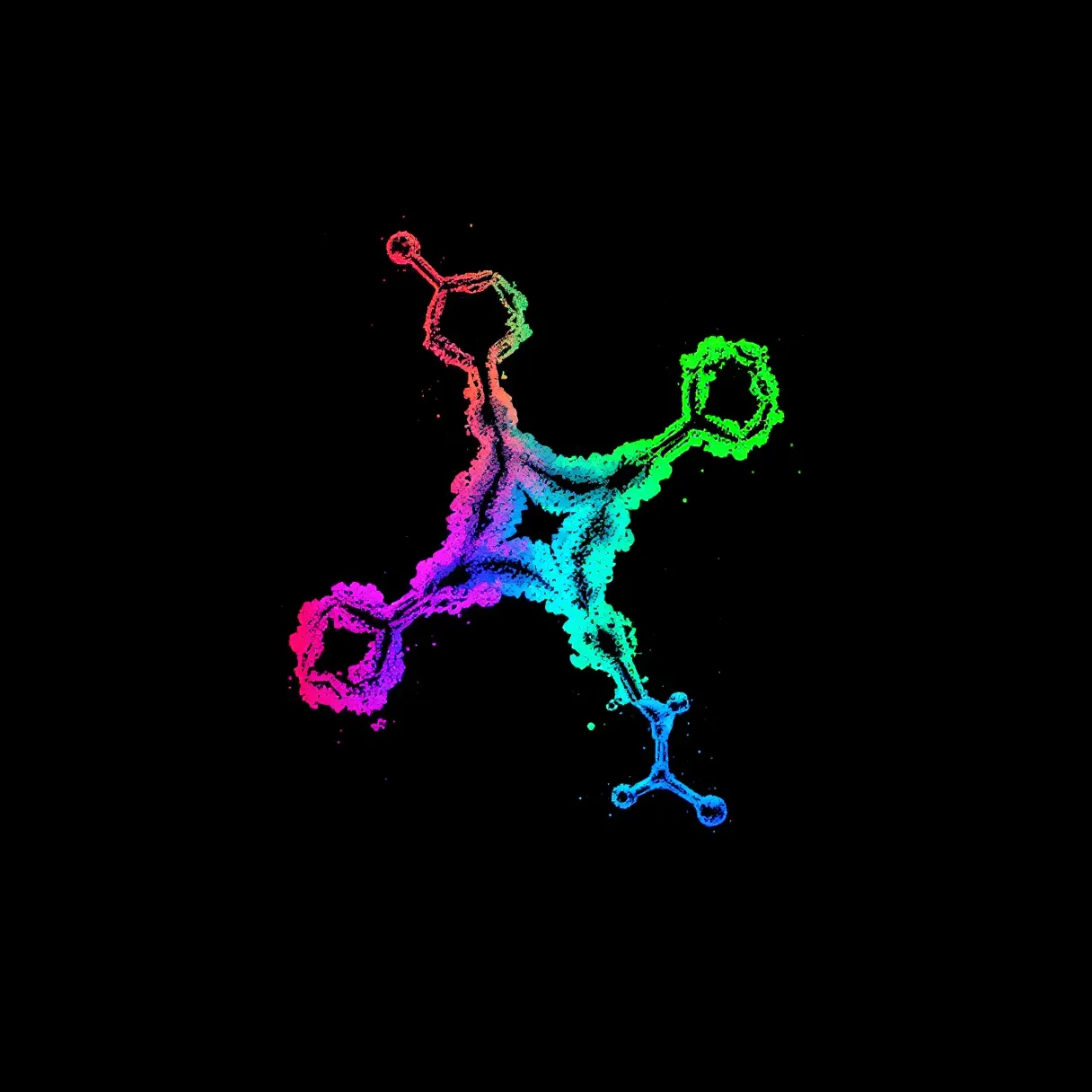
The chromatic-aberration / RGB-split design language is a deliberate argument made in visual vocabulary. GLOW is three separately-studied compounds marketed as one stack. The three pure-RGB primaries used as a structural legend — red for GHK-Cu, green for BPC-157, blue for TB-500 — literalize that decomposition on every page. Display headings carry a chromatic-split shadow that almost-but-does-not-quite register, just as the three peptides almost-but-do-not-quite combine into a single research record.
Body text and small UI text stay clean off-white on near-black at AAA contrast at 17px — the chromatic-split treatment is strictly for display headings and decorative numerals, gated behind prefers-reduced-motion for readers who ask for less motion. The aesthetic carries the argument; the reading layer stays calm.